

[Ed. Note: This article is part of an ongoing series and online exclusive exploring contemporary artists through interviews, commentary, and visual engagements provided by art historian Asato Ikeda. For other interviews in this series, see “Art and Politics with Asato Ikeda.“]
Abstract: This interview features a conversation on art, racism, and immigration across Asian American and Scandinavian contexts. Drawing on Chang’s experiences of living and working in Sweden, the discussion examines how racialized artists navigate Nordic cultural institutions, public art systems, and welfare-state frameworks that often refuse to name race while reproducing exclusion. The interview also addresses Chang’s leadership of Konst Detox and her recent artworks, which engage ritual, migration, ancestry, and archival fragmentation as strategies of care and refusal.
Keywords: Sweden, racism, Asian America, immigration
C. Grace Chang is an Asian American visual artist, curator, filmmaker, and writer from New Jersey, living and working in Malmö, Sweden. As the chairperson of Konst Detox, an association for artists of color in Sweden, she creates, hosts, and produces the Konst Detox podcast. From 2020–2022, she founded and ran the Third Space Residency for queer, trans, Black, and Indigenous artists of color in the Skåne region. She received her B.A. in English Language and Literature, with a minor in East Asian Languages and Literatures, from Smith College in 2011 and her M.A.s from Lund University in Literature, Culture & Media (2016) and Visual Culture (2018).
Asato: Would you like to start by talking about your work for Konst Detox, where you’re the chairperson?
Grace: Konst Detox is an association and loose collective here in Sweden. We have 400-plus members located throughout the entire country, from the north to the south. We’ve done conferences, research trips, podcasts, retreats, and workshops with people from Norway, Denmark, Finland, and the UK.
It basically came about organically after a conference. The few people of color at this unnamed conference in Sweden looked around, saw each other, and said, “Can we get a beer after this? I need to unwind.” It also became a way of creating safer spaces for rest, development, networking, and support, because a safe space is always something of a platonic ideal.
Asato: I live in the United States, where of course there is racism, but the form of racism in Sweden may be different. What kind of context do artists of color live in in Sweden?
Grace: The global images of the Nordic countries — outdoor life, tall blond people, “healthy” culture — were pretty much my impression before living here. That identity was also deliberately constructed in the 1930s and 40s through modernist movements and the World’s Fair. It was a marketing project that shaped ideas of what “the Nordics” are.
We have to deal with the actual realities that are here, which is racism. It just appears differently. It’s difficult to have that conversation, in any space, but especially a workspace. The basic understanding that the racism actually exists, that race is a thing, is missing.
So today, the legacy we’re living with is that no one wants to talk about race on census data. It’s illegal to include that information. You cannot, in a job posting, say, we would like to have a Black creative direct this firm.
The Swedish word race, ras, is perceived extremely badly. It’s as if you just made a swastika poster and waved it in the room. That’s the reaction you usually get, where everyone’s clutching their pearls. We live with the reality of racism either way. You could just acknowledge it, and then we can solve things from there, but you can’t solve a problem that has not been acknowledged.
In 2019, Swedish artist and curator Sarah Tawia Svärd curated an exhibition at Bångska Våningen in reference to an earlier study stating that only 3.5% of exhibited artists at established galleries in Stockholm were people of color. But that number just does not reflect the reality. I’ve had so many conversations with people outside of this category of cis, white, straight, middle class, who have said, “I’m not an artist,” and they will show me what they’ve done and it’s art! I’m not here to say what is art and what isn’t. What I am saying is that a lot of vital visual culture is being created by people who are not acknowledged.
Asato: I do remember going to the Royal Academy in Copenhagen. The artists in Scandinavia could be very diverse, but that diversity is not reflected in art historical training or the curatorial department in major museums, those people who “judge” art.
Grace: It’s a big problem. It makes me really angry. This is a problem that exists almost everywhere in the “Global North,” where you have these institutions, big or small, and galleries are usually run by one person, maybe two or three. But they’re still institutions. Some of them are quite old, despite being very small. And they are quite often run by middle-class or higher cis white folks. And what happens is they will have, let’s say, a temporary position that they might put out, something that they know will be time-limited, and they will hire a person of color. They do this in good faith and want to change the culture of where they work. They don’t have a lot of money right now to hire a forever position, but they can hire this person this way. It can be very extractive. It’s this weird colonial practice where they outsource all of this sort of culture-making to people who they know are not going to be hired permanently. They have disadvantageous wages, often, though low wages are a problem in the industry in general.
Asato: I wonder how artistic practice might be different or similar in Sweden. Living in New York City, I’m aware of the many opportunities available to artists here.
Grace: We have public art. The 1% rule is not a law but an economic policy that’s honored by many regions, municipalities. municipalities. It basically means that if you want to build something in public, a minimum of 1% of your building budget needs to go toward supporting the arts. That was implemented in the late 1930s. It was a group of artists and art workers who gathered together to lobby the government to say, “Hey, there aren’t enough opportunities for us. Everyone is leaving for Paris, or London, or Berlin. Do you really want all of your talent to just flee, because you can’t pay them?”
It’s minimum 1%, some spend 5%. It could mean that a building firm alongside the municipality will spend 1% of the budget on buying art from local artists. Or it could be commissioning a bronze statue in a square. Or a very large painting in a section of a new building
The rule sustains a lot of artists, especially those who have gone through art school and have done all the things they’re supposed to do, and there aren’t many permanent art jobs available. Public art has always been acknowledged as an income stream. But when money is involved and especially when both public and private money are mixed, issues can get more complicated, especially for poorer neighborhoods.
Up until a few years ago, we’ve also had robust national arts funding. It still exists, but it’s been greatly diminished. Regions and municipalities also offer some great grants, but their pots have also shrunk due to the right-leaning (and outright on the right) administration here.
But because of this history of strong public funding for the arts, artists here aren’t as pressured to make commercial work. They can and do, but there’s much more breathing room here to explore non-commercial works and to get experimental. It’s a direct consequence of a history of strong social welfare and public funding for the arts.
Asato: Sweden is famous for its social welfare. How does that apply to artists?
Grace: Social welfare means that artists who are single parents or in low-income households can still work as artists or at least support themselves another way while creating in their off-hours.
There are government programs that help with housing costs (even for renters) and costs associated with childcare. There are nighttime childcare centers, so that your young child will be taken care of while you’re away working a night shift.
Before this current government administration, there was even stronger arts funding in the form of many national, regional, and local public arts grants.
Many artists register themselves as sole proprietorships (one person companies) so that they can more easily send invoices for their work. It’s easy to do. I have one too.
But this gets complicated when it comes to artists on sick leave or with chronic conditions or disabilities. Technically, even self-employed people may collect money from Försäkringskassan (Swedish Social Insurance Agency) during this period. It’s great that it exists! However, it’s not designed for the way in which artists and other cultural workers work.
Many artists are on sick leave due to, for example, burnout (or know that they should be). In order to be eligible for these social insurance payments during this difficult period, they would need to close their sole proprietorships.
This turns the question of sickness into an either/or scenario. Someone with a painful chronic illness might be able to take work at unpredictable intervals and be bedridden the rest of the time. Someone burned out from overwork might be able to handle a simple commission after a few weeks of leave, and this would bolster their unpredictable income. It would also make sure that they stayed relevant, which is a big part of the creative sector as a whole.
It’s a question that others in the field of disability justice and the arts have been exploring in the last few years—to my knowledge, at least.
If you’re a cultural worker here and have what we call a tillsvidare contract, which means an ongoing contract, then you are likely a member of a union. Even if you’re a temporary worker, you can just join a union. There are any number of unions, and it’s very normal to be part of that. You can get legal support, you can ask them: “Is this contract good or bad for me?” “What can I ask for wages?” “What’s normal?”
The problem happens when you have smaller institutions that can’t pay you what you’re worth, and they know that. They usually feel bad, because all they want is to put art out there that means something to a certain chunk of the population, and they want to do it together. Often what you’re given is a contract that’s 50%, so that’s half-time, although they know you will likely be doing 100% of the work. If it’s curation, they are also expecting you to do a whole series of events, which is an entirely, different logistical job, on top of the work of curating. And they can be those people who are used to working in indie spaces. They’re not used to respecting their own time and boundaries, and even physical health sometimes.
Asato: Having lived in Denmark for one year, I think more people respect these types of boundaries in Scandinavia, or at least they’re supported by the state. People are not going to lose their jobs that easily, and they’re not going be on the street begging. People in Sweden have that safety net.
Grace: There is massive respect for what is called arbetsmiljö, which means “working environment.” If someone on your team says, “I’m feeling like burnout is imminent for me. I think I need to not answer emails after 5PM,” it’s acceptable. Whether it’s honored sometimes depends on who your co-workers are and the space. But there’s more openness to that. People died for us to have workers’ rights. People died for us to have the right to vote. People take those rights seriously here.
Asato: I would like to ask you about your latest artwork. As smoke unfurling was commissioned by curator Anna Jin Hwa Borstam for your solo exhibition in 2024 at Krognoshuset in Lund, Sweden (Figure 1). It’s a three-channel video installation, one hour in total, that shows you burning incense. You have explained this in terms of immigration, ancestral connection, and rest and refuge. Would you tell us more about this?
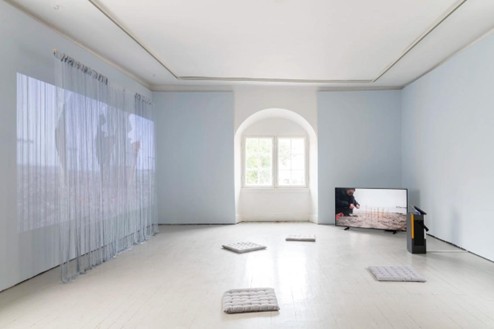
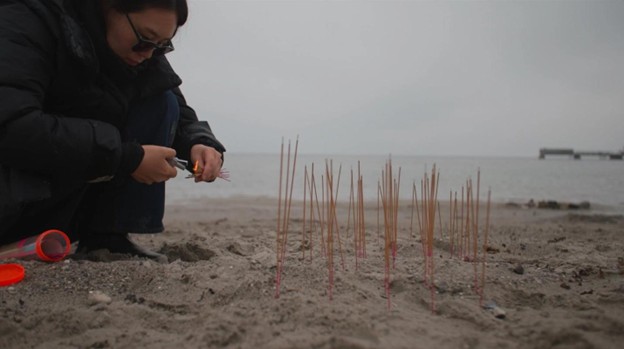
Grace: I burned a thousand sticks in total by the sea. It was inspired by Chinese and other East Asian traditions of incense burning at the Mid-Autumn festival associated with ancestor worship; this work creates a space for remembrance and contemplation.
The work deals with personal and historical matters and treats the ritual gesture as a way of connecting the living and the dead. Water is a connector. My mom immigrated to New York from Taiwan when she was nine even though she didn’t want to. She thought if she could touch the water, she would be able to, by proxy, touch Taiwan because water goes everywhere. It’s also about time and the distance between you and your dead loved ones, your living loved ones, people you have forgotten as well. I was burning incense for all of them. You can’t reach them, but the smoke can. The piece dives into the interconnection between things that rot and things that grow, things that get broken and putting them back together in these weird ways. The work evokes issues like migration and time. Generations later, there may only be pieces of all the information you have now left. And what do you do with those pieces? Especially if you are, like me, the lone immigrant of your family to come to another place. You’re in charge of that now in this place.
Asato: Did you also say that the work is also about healing?
Grace: Yeah, I think in all of my works, I have been very influenced by Yves Tuck and K. Wayne Yang’s paper about refusal as a starting point. In the 2010s when I first read that, it was like a lightning bolt. You can say no to things. Not everyone has to have access to everything. You can offer a different path. This was all news to me, for some reason.
I’ve tried to approach my practice by asking what to do with situations I find politically or morally unacceptable—whether that’s changes in immigration policy or the long, violent history of Asian America, in the United States, in Asia, and across the Pacific. I want my work to ask: Where do we go from here? Is there still a possibility for something better, a chance to heal something, or to reach toward a future we can’t yet see but hope might be kinder to someone down the line?
That’s always in the back of my mind when I make something. There is grief—personal grief, collective grief, and the grief of migration, whether chosen or not. It’s a hard process, and I want the work to hold that difficulty while still opening the possibility of repair.
Asato: You said your mother immigrated when she was nine?
Grace: Yes, it’s a weird age. It’s just before puberty, and you have an ingrained friend group.
Asato: She was from Taiwan, but your father was from Korea.
Grace: Yes, he immigrated as an adult. I am having a sort of parallel experience with him. Not at all the same, because I’m immigrating from one “global north” country to another. Even if people see my face and don’t treat me well, when I open my mouth and speak English, it’s a different story. I resent that as much as I am relieved.
Asato: Would you tell me about another work of yours, Long time no see (jia gú boh kuàⁿ dio lì) from 2023, which was commissioned by Konstnärshuset for an exhibition at their satellite location, Eldhunden (Figure 2)?
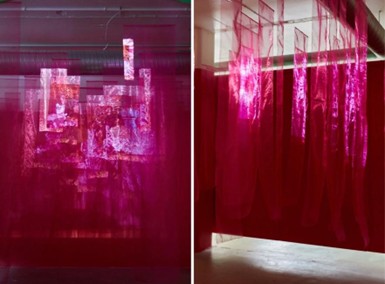
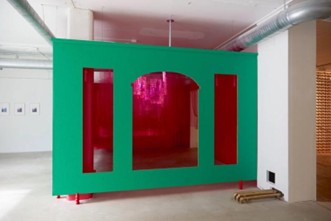
wood, textile, video (17:53). Sound by Clae Lu.
Grace: The other half of the title is in Taiwanese dialect. I think it’s the dominant dialect, but not a lot of people speak it anymore, because it’s considered low-class or old school. The work was about my mom’s mom when she passed away in the States. She died in New York. Her place used to have a Buddhist shrine, which was later removed by my aunt, who was Christian. I had no words for how angry I was. I couldn’t stop fixating on this one part of the wall that used to have that Buddhist shrine. I thought if I could imagine if that part of the wall could be a portal, to some other space, a softer space, or a space that can hold everything, both the grief and all the things that were possible because of the different steps each of us has taken in this country. The wooden structure, painted in green here, was inspired by that Buddhist portable shrine at my grandmother’s place.
Asato: You have photographs of your mother and grandmother inside the structure.
Grace: Yeah, exactly.
They are photos of objects or photos that I had taken in New York and New Jersey. These are parts of my mom’s family’s archive. I made copies of those to store on a backup drive and created copies of copies of copies. I had this extreme anxiety of caretaking, because I can’t move the archive, because what if I lost it, and then it’s all gone?
The outer Buddhist shrine part looks like a clean green box, sort of melon green, and very happy. The inside is this pink chaos. There are tons of these thin pink fabric panels, and the video of my family photographs are projected onto them. The installation came with the sound I commissioned from an artist based in New York named Clae Lu. They play a traditional Chinese instrument, called a guzheng.
The pink panels are made of polyester organza, so it’s not a precious material. It’s also a lot tougher than a thin silk organza, and it gives more of a sheen and a glitter when the projector is on it. I wanted it to shimmer almost like water, for it to feel a little bit unreal as well. If you looked from outside or inside, it was always broken. No single face could really show. I don’t think brokenness is good or bad, it just is. Things are fragmented, even for people back in Taiwan, because they also have complex identities. The fragmentation doesn’t end.
The idea was that the viewers were able to move through it and they can also touch it. The chaos was structured, but my top nightmare was people would walk in and my relatives would just be available for easy consumption.
My grandmother really was the matriarch, and when the matriarch dies, everybody feels it. It was as if the parameters of your existence have shifted, forever. Her whole life is boiled down into whatever we say about her at the funeral, and whatever photo materials or designer clothes or anything she has left. We are reduced to what we leave behind. It’s the fragility of stories and whole lives distilled into what’s left behind, but it is also the joy that you experience together. You appreciate the experiences you have together while you can. I was inspired by Homi Bhabha’s theory, and my work was a spatialization of that kind of hybridity, because you cannot go back to what was.
Asato: Maybe you could talk a little bit about your current project, the stage adaptation of a book called She Is Angry?
Grace: It’s based on the award-winning book by Lee Langvad. It came out in 2014, and it has been translated into many languages since then. The work itself is critical of the transnational adoption system, or I would call it a scheme. There’s also exploration of queerness in there as well, as Lee is also queer, and some of it is funny as well. What I am working on is a stage adaptation of the book. Right now, it’s still in process. The cast is all Korean adoptees.
My role is the producer or production manager. Tasked partly with keeping this train on the tracks, which means on budget, on time, where is everybody at any given point in the production schedule. I make the schedule and deal with economic matters.
There are a lot of measures being developed now in the work to make sure that it’s not just trauma porn. That was a point I made very early on when I signed on. This is one area where it could really go off the rails. It could be just focused on trauma and suffering. And of course, the book is about collective trauma. That is the backbone. But we need to highlight these other things, and we’re all in agreement on this. It will premiere on March 18th at Tehachtenn in Kulturhuset in Stockholm.
Asato: You already have a date! Great. I might come!
Grace: There is going to be a talk with the author Lee Langvad. We’re also trying to consider that with works like this, which is very nuanced and powerful, there will likely be audience members for whom this is a very personal experience.
Asato: What language will the play be in?
Grace: It’s in Swedish and Norwegian. Parts of it will also be in Danish, and this is to reflect the fractures that transnational adoption has created. It will tour in Copenhagen in the fall. Growing up, I was surrounded by other immigrants who meant to immigrate or who had consciously fled something. I’m very grateful to have met transnational adoptees as a grown-up and hearing their experiences and been let in on these stories. Some of their stories are unjust and shocking. Asato: In recent years, some adoptees have criticized the transnational adoption system, particularly highlighting instances of corruption and fraud as well as the racial dynamics involved when individuals in wealthy, predominantly white countries adopt children of color. While South Korea looms large in this movement, it is not the only country implicated, correct?1
Grace: No, there are a lot of other countries where children are more or less being sold, through agreements between governments or agencies. China, for example, has had this. Russia has had this. Countries in Latin America as well have had this. And for sure, throughout Africa as well.
Asato: Thank you very much for our conversation today. It was a pleasure to discuss transnational migration and artistic practices engaging with this theme across regions, spanning not only Asia and the Americas but also Scandinavia.
- For more on this topic in Denmark, see, for example, “Victims of Denmark’s adoption scandal demand answers,” France 24, 3 January 2024. Al Jazeera’s documentary series Witness includes several episodes on transnational adoption. See, for example, “Child of Their Time: The Emotional Cost of International Adoptions,” which follows an Indonesian adoptee in the Netherlands, and “No Place Like Home: Tracing Roots from Norway to Sri Lanka,” about a Sri Lankan adoptee in Norway. NPR’s Code Switch podcast features an episode on racial identity and transnational adoption titled “Our Homeland Is Each Other.”