

Abstract: Rabson introduces Sleeper’s novel about an American journalist in Okinawa during the 1990s, asking her about the autobiographical elements and what she learned during her own time living in Okinawa.
Keywords: U.S. military bases, Okinawa, anti-base protests, US-Japan alliance, literature
Introduction and Interview by Steve Rabson
The novel Gaijin is loosely based on journalist and author Sarah Z. Sleeper’s four years in Okinawa. Sleeper worked as a writer and editor there from 1993 to 1997. She raced in a dragon boat against Okinawan school teachers, studied macrobiotic eating with an American expatriate couple, explored the art of a prominent Okinawan quadriplegic painter—and wrote about all of it for a local magazine, This Week on Okinawa.
Sleeper says she was a “sponge,” taking in the local culture as well as that of the U.S. military, with a special focus on how the two interacted. It was a formative period at the start of her career, and she took on extra work as editor for the American Chamber of Commerce on Okinawa, and for the marketing department on Kadena Air Base. She had a unique vantage point as neither a Japanese citizen nor part of the military, so a bit of a gaijin in both situations.
Her novel Gaijin debuted in 2020 to glowing reviews. The seeds of the story sprouted while Sleeper was in Okinawa, and she updated the fictional tale by adding contemporary news and data. Her research about sexual assaults committed by servicemen against Okinawan women add a startling and important element to the book.
Here’s what author Porochista Khakpour wrote about Gaijin: “This story of the ‘unwelcome foreigner’ is not an easy one, and it takes an award-winning journalist like Sarah Sleeper to give it the precision, sensitivity, and depth it deserves. The Far East and the Midwest are both on trial as Sleeper investigates the past and present of Japanese-American relations through a haunting, unforgettable story of love lost. Sleeper’s prose is full of natural poetry as she explores all the different shades of heartbreak where personal and political intersect.”
In this interview, Sleeper discusses how she adapted to life in Okinawa in the 1990s and what she learned from the experience. She then shares an excerpt from her novel.
Rabson: What brought you to Okinawa in the first place?
Sleeper: I was married at the time to a civilian employee of the U.S. government. When he accepted an assignment there, I moved there with him.
Rabson: You were in Okinawa from 1993 to 1997, with a visit to Tokyo?
Sleeper: Yes, I was there for almost four years. I traveled to Osaka and Tokyo while I was there, and also to South Korea. But keep in mind that I was young and poor and so my travel budget was limited. I mainly immersed myself in local culture and tried to learn all I could. In addition to my work as a reporter and editor for an English-language magazine, I rode my bike up and down the island, studied Japanese at a local school, and learned to scuba dive on the coral reef in the East China Sea. I packed quite a bit into the three-and-a-half years I was there.
Rabson: What things did you read about Okinawa before, during, and after you were there?
Sleeper: When I moved there, I was utterly unprepared. I was young and newly married, and determined to start a writing career. It was pre-Internet and if you recall, research was much more laborious at that time. But when I landed, I hit the ground running. I found This Week on Okinawa right away and applied for a job. I realized that the magazine was run by Americans and owned by an Okinawan, so it was an excellent place to learn about many things, including American-Okinawan relations and how Japanese workplaces operated. I still feel so lucky to have found that job—it was an absolute life-changer in that it gave me many opportunities to experience and write about Okinawans as well as about the U.S Air Force, Marines, Army and Navy.
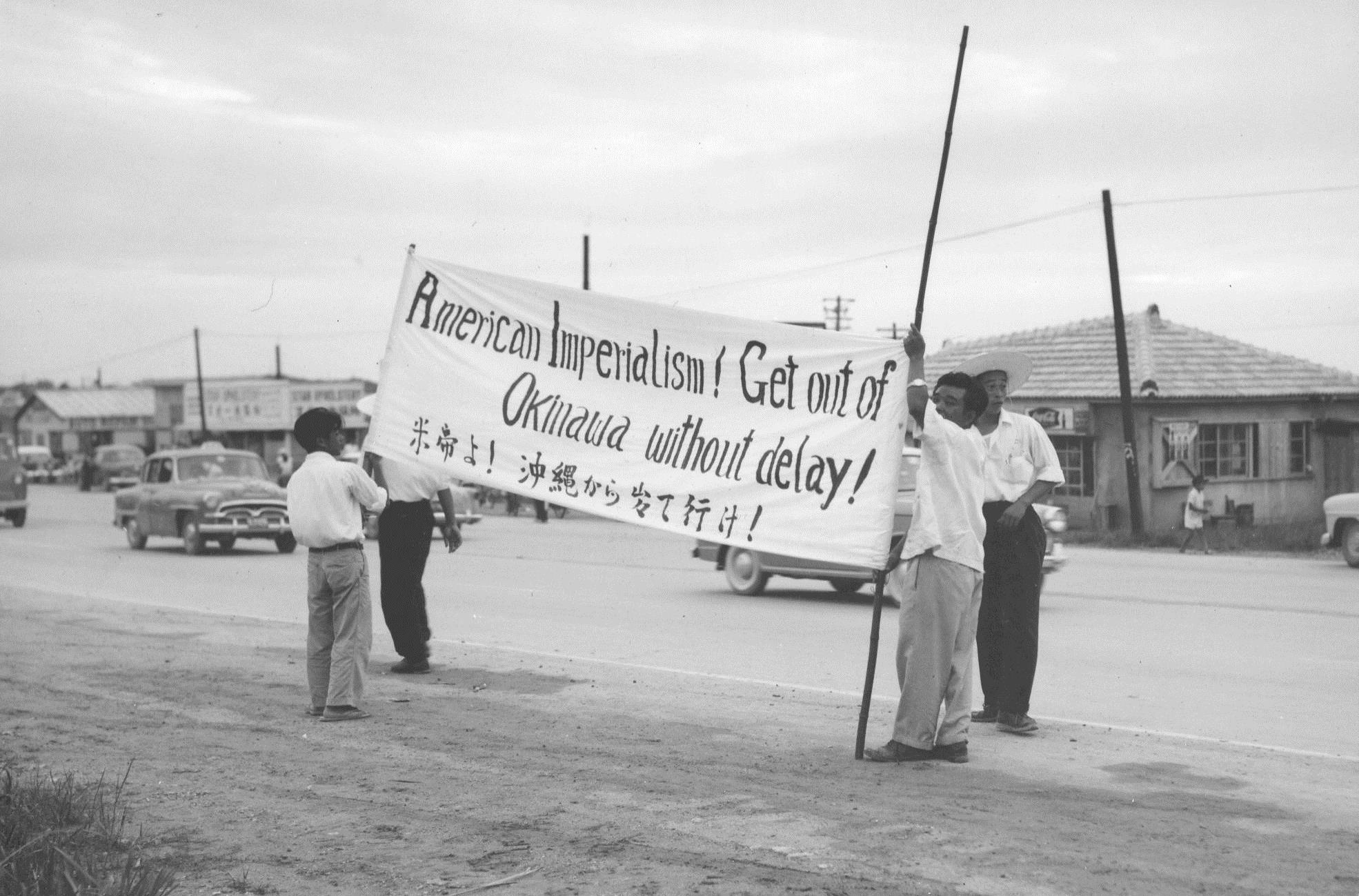
My apartment was right off Kadena Gate Street and I took daily walks and drives to familiarize myself with my new surroundings. That was where I first saw street protests about the U.S. military presence. It was pretty much immediately clear to me that the relationship between Okinawans and Americans was complex and sometimes fraught. It was a lot to take in, but I was young and irrationally fearless. Just ready to make the most of my new home and my career.
Rabson: Were you aware of differences in the cultures and histories of Okinawa and mainland Japan? If so, what in particular?
Sleeper: That awareness dawned over time as I worked as a journalist. I realized fairly quickly that there was some tension between Okinawans and mainlanders, but it took me a while to recognize the nature of the division and that some Okinawans felt discriminated against. That some Okinawans felt they were part of the Ryukyu Kingdom and retained that cultural identity more than they felt Japanese. It didn’t take much reading to understand that the island was conquered by the Japanese, and then victimized by WWII. It was not surprising to me at all that some Okinawans resented both the Japanese and the Americans. As I continued reading, experiencing the culture first-hand, and writing about all of it, that knowledge certainly informed my novel.
Rabson: You were in Okinawa during the 1995 child gang rape and its aftermath. What do you particularly remember about it?
Sleeper: I recall being horrified, as was the staff at the magazine, of course. It led to big protests and a tense environment and it stuck with me as a terrible memory. That crime was not the origin of my novel, Gaijin¸ but it felt necessary to include such information in my book. How could I possibly write about an American in Okinawa without addressing the fact that sexual assaults have taken place ever since the U.S. military was there and continue to this day? This is not to say that Okinawans don’t commit crimes too, but since my character Lucy was an American, it was imperative that she be witness to that type of situation. And as a woman, I’m sure I felt that it was important to report on the real numbers of such crimes, so I do that in the book. Probably because I’m a journalist as well as a novelist, I wanted my book to be “true” in all the important ways. The facts of relations between Okinawans and American military are real and true, while the specifics of Lucy’s story are fiction. That’s the best kind of novel, in my opinion, in which characters deal with real life situations.
Rabson: How do you think Lucy’s experience as a gaijin in Japan would have been different if she was as man?
Sleeper: Well, for one thing, her experiences in business may have been quite different. I recall (and wrote about it in the book) that at my magazine office, the graphic artist (an Okinawan woman) would stop her work each afternoon to serve tea to the press men and publisher. She didn’t serve tea to the Okinawan or American women in the office and there were no American men there. I never felt slighted by this practice and I understood it as a cultural difference, but I did wonder if I would have been served tea too, if I were a man. I was the editor, the next ranking employee after the publisher.
Anyhow, there’s no doubt that in Japanese culture as well as in American culture (including on the military bases) women and men experience different things. Here’s an interesting memory—My husband was a high-level civilian employee of the U.S. government. This led to an invitation for me to join the officers’ wives’ club. At the time I was unfamiliar with the workings of the military and unclear on what this club was. Anyhow, I attended an introductory meeting and to say I was out of place is an understatement. As a woman working in the local community much more than I was part of the military community, I was truly a gaijin in that group. Needless to say, I didn’t join it. But I will always remember the remarkable patriotism and loyalty of those American spouses. I was neither American military, nor Okinawan, and so the beginnings of Gaijin started to hatch.
I have many stories to tell about how much I learned in Okinawa. During my years there, I had cultural immersion into three unfamiliar worlds: Okinawa, Japan and the U.S. military. In my novel, I tried to capture those experiences as a newcomer to all of it.
Rabson: Why did you choose to share with us this particular excerpt from the novel?
Sleeper: The novel has quite a few passages that readers might find startling or educational. But I believe that few Americans realize the extent of protests that take place there all the time. I attempted to describe the protest scene accurately and with enough detail to bring it to life for readers.
Chapter Twelve
The street protests raged on. There was no violence, but the rhetoric became more threatening; in one news photo, a protestor held a placard, “Death to Americans!” My driver mapped out a route, so we’d pass the crowds from a safe distance. I watched local news on the television in my hotel room, sipping cool white wine to dull my sharp edges. Outside every American base, Okinawan citizens raged, waved signs and chanted calls for Americans to leave their island for good. . .
It was time to start my first assignment, a story about a retired Marine and his Okinawan wife, who’d launched a controversial new dating website, MarryAmerican.com, devoted to hooking up local women and American men. I’d read that some Okinawan women wanted to marry soldiers or sailors and move to the United States, and some servicemen wanted shy and subservient Japanese wives. I found these notions repugnant, but they also piqued my curiosity. Would I be able to find men willing to go on the record about this? Would Okinawan women be willing to be interviewed? Wasn’t this akin to American sites like Sugarbaby.com or MarryaMillionaire.com, where daters chose each other for money or sex? And in light of the unrest on the island, was it okay to highlight American-Japanese couples who met this way? I texted Amista with my worries. She said Okinawa Week covered all kinds of stories, not just the biggest news, and I should consider myself lucky to have a fluff piece amidst all the strife.
During my research I came across a reference to “Bride Schools,” a set of classes put on by the American Red Cross for Japanese women marrying American men after World War II. In the nineteen-fifties, forty-thousand Japanese married G.I.s during the post-war occupation, and in the most patronizing, belittling way imaginable, the Red Cross took it upon themselves to offer to train the Japanese women on how to use washing machines, cook pot roast, host social events and so on, the way American housewives of that era did. It was sanctioned, gender-based brainwashing. That was more than a half-century ago, but to my surprise, in addition to MarryAmerican.com, I also found present-day social groups and nightclubs that existed specifically to connect American men with potential local spouses.
With that new information, the knowledge that as in the fifties, American-Japanese hook ups were a “thing,” I wasn’t surprised that it took only one day for me to find men and women to interview. I contacted the PR man from the website, and he gave me names. The first two couples I contacted were more than happy to be interviewed for my story. Since I didn’t have a car yet, Ashimine-san hired the hotel driver to take me to the appointments.
The first interview was at a modest concrete apartment on a residential street with a tatami mat at the front door for shoes. The mat jolted my memory to the mat where Owen and I placed our shoes in his fort during a makeshift tea ceremony. At the time, I hadn’t realized it was a traditional straw tatami. I was becoming expert at ignoring my nagging questions and memories while I was at work. When I was off work, I was a mess, drinking, worrying. Owen invaded my thoughts and I was itchy to see Hisashi again.
The door opened and I was greeted by the jowly, retired Marine who’d launched MarryAmerican.com, along with his pretty Okinawan wife. He wore faded jeans and shook my hand too tightly. We sat on a tattered couch and before I could ask a question, he said, “I suppose you want to know why we launched this site.” I didn’t have a chance to respond before he continued. “I’m so happy with Kimiko here, I figured other couples could be happy too. She’s the best cook and look at how clean our house is.” Kimiko nodded and stared at the floor and the Marine patted her knee. “She never leaves my side and only talks if I ask her to.”
I held my face in expressionless sincerity, tightening my lips to hide my disgust. “May I ask her a few questions?” I said, trying to look indifferent. He agreed to translate.
I asked if she’d always wanted to marry an American and she said yes because they were “nicer” than Japanese men. I wanted to know if she’d dated Japanese men before and she said no, only Americans. I asked if that was a common choice and she said she didn’t know because she doesn’t have friends.
The Marine jumped in. “She doesn’t need outside friends. We’re happy with each other.”
I asked the Marine if MarryAmerican.com was successful and he said there’d been more than thirty dates set up in the first few weeks. “I’m not in it for the money,” he said. “Just to help guys like me find gals like this.” He again patted his wife’s knee and kissed her on the top of the head. She shot me a serious look I couldn’t read.
I was curious how this rough man had managed to woo this lovely woman, but no way I could ask that. “Your site didn’t exist when you and Kimiko got married,” I said, “where did you meet each other?”
“She was a stripper. I liked the bar where she worked, and I liked her better.” As if she understood what he said, Kimiko looked away, ill at ease.
I left the suffocating house and took a gulp of air. I collected myself and headed to the second interview in a similar small beat-up home. There, a young Okinawan newlywed with bright blue eyeshadow told me, “Ray is sweet. He lets me go out for coffee with friends when he’s at work.” I cringed at her use of the word “lets.” I knew some Japanese still adhered to traditional gender roles, but it was hard to fathom the type of patriarchy I’d encountered at the two homes. My own parents had been strictly egalitarian, and I wasn’t prepared for such stereotypes as these.
Back at work, I slogged through the writing process, trying not to sprinkle the piece with my cynicism. My story was published two days later along with photos of the happy couples that I’d taken myself. “How to marry an American,” earned me a set of disgusted emails. “Since when is it news that Japanese women try to steal our men?” said one email, from a woman who called herself “Flyboy Wife.” I showed this email to Amista.
“Obviously that’s a woman whose husband is an Air Force pilot,” she’d said. It hadn’t been obvious to me . . .
During my first weeks, Ashimine-san promised that I’d get a chance to cover bigger stories, but that I had to be patient. “Chotto matte kudasai,” he’d said, a phrase he often repeated: “Please wait a moment.”It was a bit of Japanese that could fit any number of circumstances: a delay in earning the attention of a waiter, a too-long hold on the phone when trying to schedule an interview. In Okinawa people said the phrase constantly, chotto matte kudasai, and Ashimine-san said it most of all.
“May I cover Prime Minister Abe’s visit?” I’d asked, after reading that Japan’s leader would be coming to Okinawa to address the protestors’ demands.
“Chotto matte kudasai,” he’d said. “It’s not yet your turn. You will earn your way to cover top stories.” He smiled with such kindness that if I hadn’t heard him, I would have believed he’d said hai . . .
The trial date hadn’t been set yet, but reporters from the mainland and from the U.S. were swarming the island and there were media events scheduled every day, different members of Midori’s camp and of Stone’s, making their cases to the journalists. Amista asked me if I’d like to tag along with her for those events when I was free. It would be a good experience, she said, for me to participate in such a major story. I wanted to go with her, but I was uneasy, not sure I could handle the anti-American hostility on top of the sadness I felt for the alleged victim. . .
Ashimine-san hadn’t yet assigned me a second story and Amista told me he was giving me time to settle in. During my free time I kept tabs on the rape case . . . The word gaijin kept popping into my mind. Owen had called himself a gaijin both in the U.S. and in his own family. Maybe I understood now, a little, because of feeling like such an alien in Okinawa. So much was going on around me, so much conflict and drama, but I was on the outside of it all, an observer more than an active participant . . .
Chapter Twenty-Four
. . .
“Miss Tosch? Lucy?”
“Yes. Takazato-san?” She came over and took both of my hands.
“Please call me Akari.” She offered us two metal chairs by her desk, and we sat. On the walls were photos of Japanese women and girls, their names and the dates of the crimes against them. “Mika Sakaguchi, May 30, 2015,” “Yuka Tomayasu, February 2, 2001,” “Chieko Aiko, October 2, 1995,” and on and on and on, all the way back to “Etsuko Fumie, December 10, 1972.” Akari watched me take it all in. The faces of the women looked out from the wall, smiling, the photos taken at some happy moment before their assaults.
“It’s difficult to see these faces, knowing what happened to them,” Akari said. She leaned forward thoughtfully and pushed a wisp of hair behind her ear. Her clothes were utilitarian, leggings, sneakers and a plain black t-shirt. “I know you have your questions, but may I first give you some statistics?” I nodded. “These one-hundred-and-twenty photos represent the reported rapes of Japanese women by U.S. men. There are thousands more, unreported,” she said. In 1972, the U.S. military occupation of Okinawa ended, she explained, and before that no data was kept. The Battle of Okinawa ended seventy-one years ago, so for almost thirty years, rapes and other crimes were undocumented. She paused while I absorbed this data. “Heartbreaking, isn’t it?”
“How do you know there have been thousands of unreported rapes during those years?” I was in reporter mode, far off my script of questions about collaboration between women’s groups and determined to get the story she wanted to tell. She maintained a friendly demeanor, smiling and polite but beneath her professional polish, I sensed her passion for this cause.
“Lucy, you know women are reluctant to report rape. Even in the most civilized countries and situations, few women come forward.” . . .
“Do you have data to back up your claims?” It wasn’t so much that I doubted her veracity, but I needed proof for any story that I might eventually write.
“Your own government provides compelling data,” she said. “In 2012, the U.S. Department of Defense announced that in one year there were an estimated nineteen thousand sexual assaults inside the armed forces. Soldier on soldier, not even counting soldier-civilian instances. Nineteen thousand, in one year. Hard to grasp, isn’t it?”
“I don’t see how that relates to Okinawa.”
“Well, consider that in a press conference in Washington D.C. your government spoke about the rape of a woman soldier by her superior officer. They talked about it as an example of all that was wrong in the U.S. military. That rape took place on a base on Okinawa. If rape can happen on base, can’t you see how it can happen even more so off base, where soldiers roam freely?”
This woman was beyond articulate. She provided me with data, quotes and context, not only for a news story, but for the broader story about what was happening on Okinawa. I might not be able to use it but would pass it along to Amista.
“Let me give you an anecdote,” Akari said, pointing to a photo on the wall of a young girl, snuggling a creamy brown rabbit on her lap. “In 2005, this ten-year-old girl was victimized.” After hearing that news, Akari explained, another woman came forward to report that twenty years earlier, three American soldiers raped her. Because she didn’t take the case to court, it wasn’t counted among the one-hundred-and-twenty. “I wonder how many more invisible victims there are? From every year and in every era?”
The truth of her statement settled into me. I knew she was right and felt deflated by this sad set of facts. I changed course and asked, “What is the goal of your group, Women Against Military Violence?” I knew she probably had a stock answer, but I wanted to hear how she put it.
“Our goal is to reduce or remove U.S. forces from Okinawa. This as the only way to end the violence that comes to us from the bases.”
I wanted to bring the conversation around to my story, although my story seemed silly at this point. “Akari, the subject of my piece is how you work together with American women’s groups.” I sounded ridiculous, but I went on. “Do you work with American women’s groups?”
Akari’s face went hard. “We work with anyone who will fight to end U.S. violence against Okinawans.” She sat back in her chair, serious now. “What about you, Lucy? Will you work with us to end violence against women?”
She’d turned the tables on me, and I didn’t have an adequate answer. “I’m here as a reporter,” I said, lamely . . .